
Traditional vs. AI-Powered Marketing Strategies: What Really Works in 2026?
Let’s define how marketing strategies have changed
For decades, “traditional marketing strategy” meant research-heavy annual plans, fixed budgets, and campaign calendars built months in advance. Teams relied on periodic surveys, focus groups, media buys, trade shows, and static content to reach broad audience segments. Decisions were guided by experience, intuition, and delayed feedback (think quarterly reports or post-campaign retros).
Three powerful shifts accelerated the move beyond this model:
- Digital transformation: Always-on channels (search, social, email, marketplaces) made marketing measurable but also more complex.
- The data explosion: Every click, view, and interaction now generates signals. Brands suddenly had more data than humans alone could interpret.
- Rising expectations: Customers expect relevance in the moment personalized content, timely offers, and seamless journeys across devices.
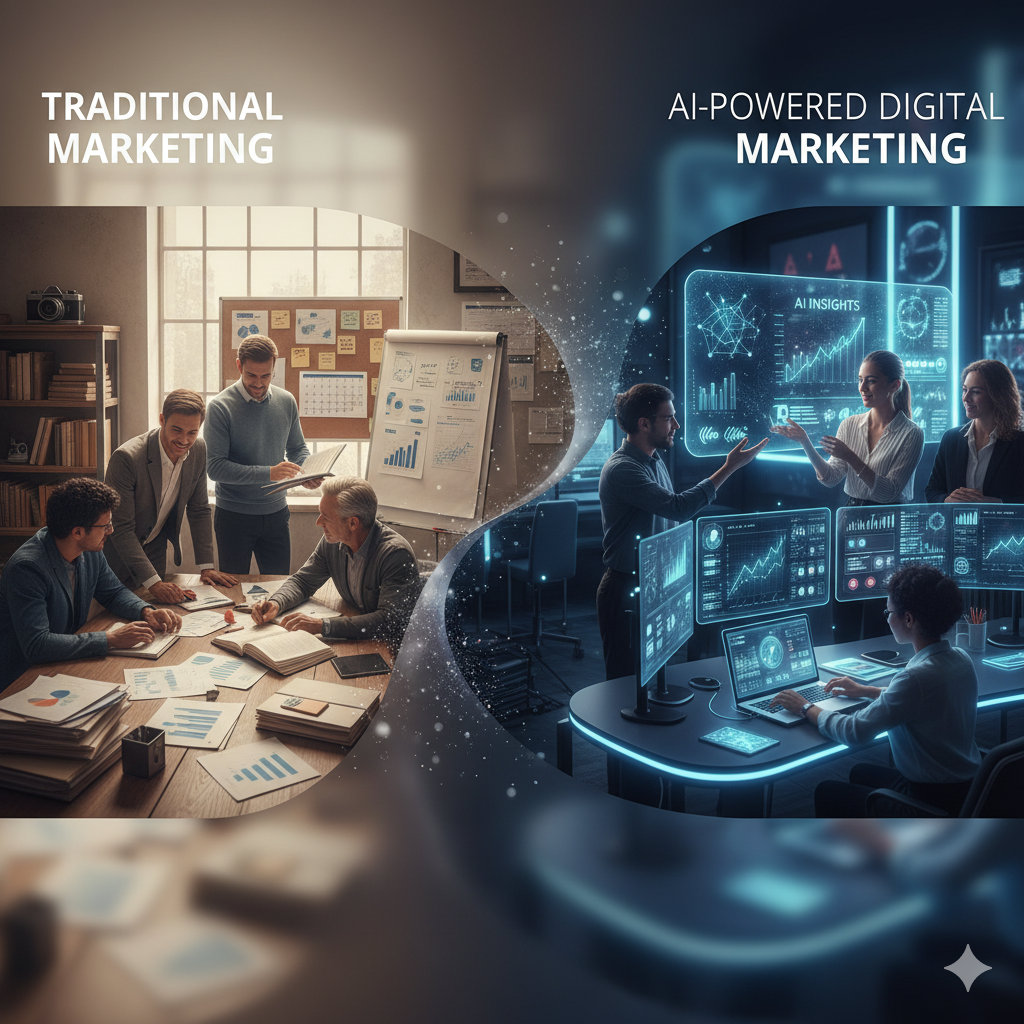
Enter AI-powered marketing—the natural next evolution. Instead of planning in long cycles and reacting after the fact, AI systems process massive data streams in real time to predict behavior, personalize experiences, and continuously optimize spend. The marketer’s role shifts from manually orchestrating every step to setting strategy, choosing guardrails, and supervising intelligent systems that learn and improve.
What makes AI-driven marketing different?
If traditional marketing is like driving with a paper map and scheduled pit stops, AI-powered marketing is closer to using a live GPS that reroutes automatically based on traffic, weather, and your destination then learns your preferences over time.
1) Automation that actually compounds
AI handles repetitive tasks at scale: audience segmentation, keyword clustering, ad creative variations, send-time optimization, and budget reallocation. The more data it ingests, the better it gets reducing manual work while improving outcomes.

2) Personalization without guesswork
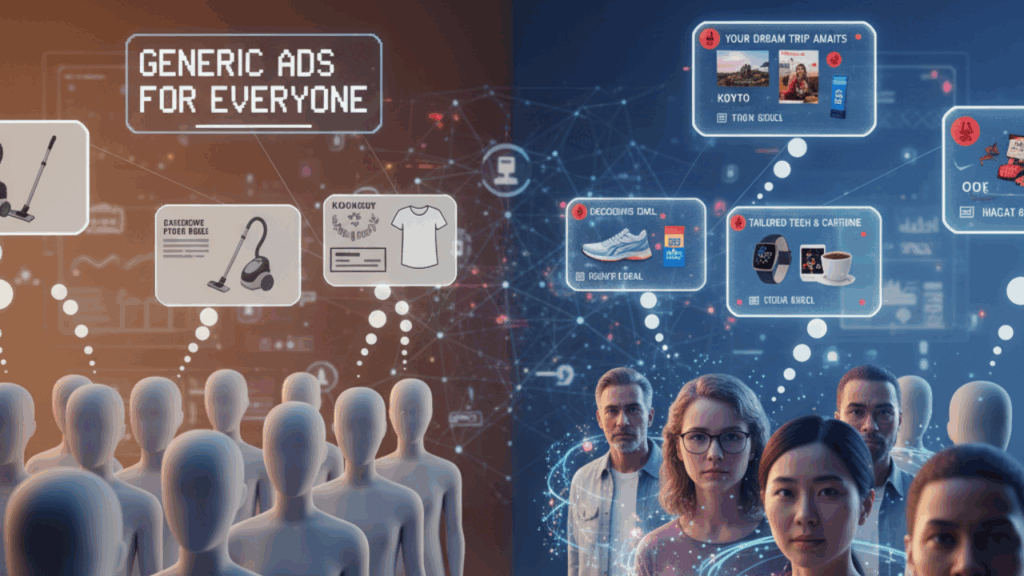
Instead of broad personas with generic messaging, AI uses first-party and contextual data to tailor content to each visitor: product recommendations, dynamic copy, pricing offers, and next-best actions updated in milliseconds as behavior changes.
3) Prediction and real-time optimization
AI isn’t just reporting; it’s forecasting. Models score leads, predict churn, estimate lifetime value, and allocate spend to top-performing channels and creatives then adapt as performance shifts. Traditional campaigns are static; AI campaigns are living systems.
Examples you can put to work:
- AI content creation & QA: Generate outlines and drafts, then enforce brand voice and compliance using rule-based and LLM-based checks.
- Micro-segment clustering: Uncover hidden audience groups based on behavior and value.
- Creative multivariate testing: Spin up dozens of headline and visual variants, then converge on winners faster.
- Conversational capture: AI assistants qualify leads 24/7 and route them to sales with context-rich transcripts.

Here’s how the two approaches stack up side by side
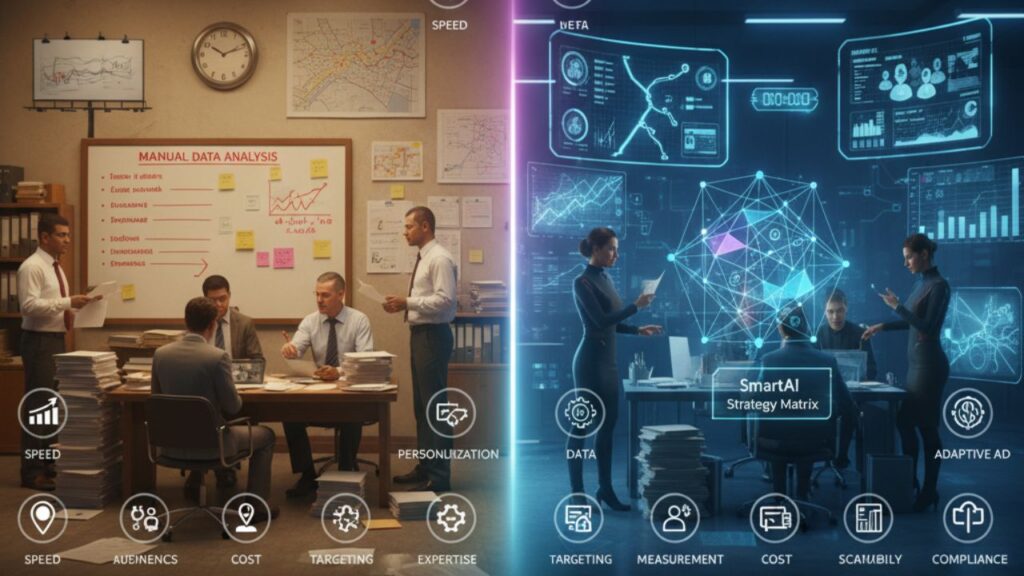
Below is a practical comparison of traditional vs. AI-powered marketing, grounded in what we implement at AI Smart Ventures. We’ll also reference our SmartAI Strategy Matrix our proprietary framework for aligning business goals, data readiness, and the right AI tooling.
| Factor | Traditional Marketing | AI-Powered Marketing |
| Speed to Launch | Weeks to months (research, approvals, production cycles). | Days to weeks; automation accelerates research, ideation, and testing. |
| Use of Data | Primarily historical and sampled; insights lag. | Real-time, event-level data across channels; insights drive immediate actions. |
| Personalization | Broad segments, limited variants. | 1:1 personalization at scale with dynamic content and offers. |
| Learning & Adaptation | Static until next campaign or quarterly review. | Continuous learning; models adjust daily or hourly based on outcomes. |
| Cost Efficiency | Fixed media buys; manual optimization; creative cycles are expensive. | Budget shifts to what’s working; creative and placement optimized automatically. |
| Targeting Accuracy | Demographic and interest-based; larger waste. | Behavior, intent, and value-based; reduced waste and higher precision. |
| Measurement | Post-campaign reporting; limited attribution clarity. | Near real-time incrementality tests, multi-touch attribution, causal lift. |
| Required Expertise | Channel specialists, copy/design, analytics. | Strategy leads + data/AI oversight + enablement; less manual elbow grease. |
| Scalability | Team size limits output. | Nearly unlimited variant testing and channel breadth via automation. |
| Compliance & Brand Safety | Manual review; slower controls. | Policy guardrails and automated reviews baked into workflows. |
Where the SmartAI Strategy Matrix fits
Our SmartAI Strategy Matrix maps your objectives (e.g., pipeline velocity, CAC reduction, LTV expansion), data maturity (first-party data quality, attribution setup), and operational readiness (talent, tools, governance). From there, we sequence AI use cases from quick wins (e.g., AI-assisted content, paid media optimization) to strategic moves (e.g., predictive LTV modeling, omnichannel personalization, marketing mix modeling). This ensures you adopt AI in the right order and de-risk change.
When traditional still wins
- Brand-building milestones (flagship events, PR tentpoles)
- Highly regulated claims requiring extensive human legal review
- Niche markets with limited data (early-stage with sub-1,000 contacts)
When AI is the obvious choice
- Performance marketing with >$25k/month in media
- Large catalogs or content-heavy engines (ecommerce, marketplaces, publishers)
- Multi-region or multi-language operations where scale matters
How do you know which strategy is right for your business?
You don’t have to choose “all traditional” or “all AI.” The best 2026 strategies combine solid fundamentals with targeted AI adoption that compounds over time. Use this quick framework to self-assess:
1) Clarify objectives
- Are you trying to lower CAC, increase LTV, shorten sales cycles, or expand into new markets?
- Which metric, if improved in 90 days, would change your trajectory?
2) Evaluate data maturity
- Do you have clean first-party data (CRM, pixel, email events)?
- Is tracking configured for key actions and conversions?
- Can you tie marketing touchpoints to revenue (even if imperfectly)?
3) Check operational readiness
- Do you have a point person to own AI initiatives and governance?
- Are brand voice, tone, and claims documented?
- Is leadership aligned on a test-and-learn culture?
AI readiness checklist (fast yes/no scan)
- We have first-party tracking for web and email events.
- CRM fields for lead source and opportunity status are accurate.
- We can produce or approve content within 48–72 hours.
- Legal/compliance guardrails for content and offers are documented.
- We’re comfortable running controlled experiments (A/B, geo-split).
- We can allocate a starter budget for AI pilots (tools + media + enablement).
If you checked 4 or more, you’re primed to benefit from AI now. If not, start with data hygiene and lightweight enablement—then layer in AI for your highest-leverage channels.
How AI Smart Ventures helps: Our AI strategy consulting process starts with a readiness assessment, data and tracking audit, and a 90-day roadmap prioritized by ROI and effort. From there, we co-pilot your first wins and enable your team to sustain them.
Explore: AI strategy consulting and AI-powered marketing

What results can you expect with AI-powered marketing?
While results vary by industry, data quality, and spend, we consistently see three outcome patterns once AI foundations are in place:
1) Faster iteration, more signal
Running 10–50 creative and audience variations in parallel reveals winners days sooner than manual testing. That speed compounds: more tests → more learnings → better models.

2) Better matching of message to moment
Send-time optimization, dynamic content, and next-best offers increase engagement and conversion, particularly in lifecycle programs (welcome, onboarding, upsell, win-back).
3) Budget that self-optimizes
Real-time budget shifts toward the highest-ROI combinations of channel + audience + creative, reducing waste and stabilizing CAC.
A (anonymized) client snapshot from AI Smart Ventures
- Company: B2B SaaS, mid-market; ~$60k/mo in paid + strong content engine
- Baseline: CAC drifting up 18% YoY; lead quality inconsistent; content backlog
- Interventions (90 days):
- AI-assisted content briefs + draft generation with brand voice guardrails
- Paid media creative multivariate testing (LLM-generated variants + human edits)
- Predictive lead scoring to prioritize SDR outreach
- Automated enrichment + lifecycle triggers (trial activation, risk of churn)
- AI-assisted content briefs + draft generation with brand voice guardrails
- Outcomes (first 90 days):
- -22% CAC on core channel mix
- +31% SQL rate from MQLs due to prioritization and messaging fit
- +18% demo-to-close improvement; +14% pipeline velocity (fewer stalled opps)
- Content velocity doubled while maintaining brand consistency
- -22% CAC on core channel mix
These are not moon-shots—they’re the result of sequencing the right AI use cases, enforcing brand/compliance guardrails, and letting the system learn. If your data and operations are moderately mature, you can expect similar directional gains.
For a deeper dive into how we approach measurement, governance, and enablement, visit: AI strategy consulting.
Here’s how the two approaches stack up side by side (visual summary + use cases)
To make the comparison even more practical, here’s a quick matrix you can use in planning meetings. Bold cells highlight where AI typically delivers an outsized advantage.
- Demand Gen & Paid Media
- Traditional: Manual audience building, quarterly creative refreshes, fixed bids.
- AI: Look-alike + intent audiences, dynamic creative optimization, real-time budget shifts.
- Traditional: Manual audience building, quarterly creative refreshes, fixed bids.
- SEO & Content
- Traditional: Keyword by keyword, copywriter-only production, monthly calendars.
- AI: Programmatic topic clustering, AI briefs and drafts with human editing, internal-link automation, content quality scoring.
- Traditional: Keyword by keyword, copywriter-only production, monthly calendars.
- Email & Lifecycle
- Traditional: Batch sends, broad segments, fixed schedules.
- AI: Send-time optimization, behavior-triggered journeys, predictive win-back and upsell.
- Traditional: Batch sends, broad segments, fixed schedules.
- Analytics & Attribution
- Traditional: Last-click or channel-only reports, slow insights.
- AI: Incrementality testing, multi-touch attribution modeling, anomaly detection and alerts.
- Traditional: Last-click or channel-only reports, slow insights.
- Sales Enablement
- Traditional: Static battlecards, manual note-taking.
- AI: Auto-generated briefs, meeting summaries, objection handling patterns, and next-best content suggestions.
- Traditional: Static battlecards, manual note-taking.
All of this rolls up into our SmartAI Strategy Matrix, which determines your starting lane (Performance, Content, Lifecycle, or Analytics) and sequences the exact AI capabilities that will deliver the fastest, safest ROI.
How do you know which strategy is right for your business? (Decision helper)
Still on the fence? Use this simple decision lens:
- If your goal is brand salience and long-term market perception—keep traditional anchors (PR, events, hero creative) and layer AI into media buying, content distribution, and measurement.
- If your goal is near-term pipeline and revenue efficiency prioritize AI in paid, lifecycle, and sales enablement where feedback loops are fastest.
- If your team is lean AI can absorb production and optimization load so humans focus on strategy, partnerships, and customer insight.
Choose your starting lane (from the SmartAI Strategy Matrix):
- Performance-First: >$25k/mo paid media; need CAC control and scale.
- Content-First: Heavy SEO/content needs; demand more output without diluting brand.
- Lifecycle-First: Large list or product catalog; growth via retention and LTV.
- Analytics-First: Leadership needs trustworthy ROI and causal lift insights.
We’ll help you validate the lane, define quick wins, and protect brand/compliance every step of the way.
What results can you expect with AI-powered marketing? (Benchmarks & projections)
Once foundational tracking and guardrails are in place, mid-market teams often see:
- 10–30% CAC reduction via budget reallocation and creative optimization
- 15–40% lift in qualified pipeline from improved matching and prioritization
- 2–3× content throughput at equal or higher quality with human-in-the-loop review
- 20–50% faster test cycles, accelerating learning and compounding gains

These aren’t guarantees; they’re reasonable projections based on the interplay of budget, data quality, creative assets, and organizational agility. The durable advantage comes from learning loops, AI accelerates the speed at which your organization learns what works.
Here’s what to do next if you’re ready to make the switch
Step 1: Audit your foundations (2 weeks)
- Confirm event tracking for primary conversions across web and CRM.
- Review consent, data governance, and brand voice guidelines.
- Baseline your current metrics: CAC, LTV, SQL rate, channel mix, content velocity.

Step 2: Identify 2–3 quick wins (30–45 days)
- Pick one Performance win (e.g., AI creative testing + budget automation).
- Pick one Content win (e.g., AI briefs + draft + brand QA workflow).
- Pick one Lifecycle win (e.g., predictive churn trigger or win-back).
- Establish success criteria and a measurement plan.

Step 3: Pilot with governance and enablement
- Implement brand guardrails (approved voice, claims boundaries, legal rules).
- Train the team on prompts, review workflows, and escalation paths.
- Run controlled experiments (A/B, geo-split, holdout) to prove lift.

Step 4: Scale through the SmartAI Strategy Matrix
Once wins are proven, expand to the next lane (e.g., from Performance to Lifecycle) and introduce advanced capabilities like predictive LTV, marketing mix modeling, and cross-channel orchestration.

We’ll co-pilot the journey with you.
AI Smart Ventures pairs AI strategy consulting, enablement, and implementation to deliver measurable gains quickly without compromising brand or compliance. Start with a focused assessment and 90-day plan, then scale what works.
Call to action:
👉 Book a free AI marketing strategy assessment to see where AI can reduce your CAC, increase LTV, and accelerate pipeline safely and fast.
Get started: AI strategy consulting · AI-powered marketing
Is traditional marketing dead?
No. Brand campaigns, events, and PR still matter. AI strengthens them by improving targeting, measurement, and follow-through.
Do we need a data scientist to start?
Not for the first wins. You need clean tracking, a willing team, brand guardrails, and a partner who knows how to sequence AI safely.
What about compliance and brand risk?
We build approvals, policy rules, and content QA into the workflow so AI stays inside your guardrails.
Traditional foundations give you focus and story. AI turns that story into personalized, measurable experiences at scale. In 2026, the question isn’t “which one?” it’s how to combine them so your learning loops get faster, your spend gets smarter, and your customers feel like you built the experience just for them.
When you’re ready, AI Smart Ventures will help you choose the right lane, ship your first wins, and build a marketing engine that learns and earns every day.