
Accenture, EY, NVIDIA, Philips, MIT & EU AI Gigafactories: 5 Positive AI Developments For Business Leaders
Hello Friend!
This week is a pretty good snapshot of where AI is really headed for business: less hype, more workflow. There’s been quite a story rumbling about all of the tech layoffs being blamed on AI when in reality it’s a correction of bloated staffing. The AI adoption has been particularly slow in these big tech companies as engineers and others refuse to adopt the available tools. Start-ups are AI first and the big guys…not so much. There are some usage stats that have been leaked and the adoption rates even internally at Microsoft are less than impressive.
We have hospitals speeding up diagnoses, consulting giants rolling out AI at scale, MIT making models more efficient, EY and NVIDIA bringing AI into the physical world, and the EU planning massive AI infrastructure. Let’s get you caught up so you can spot the opportunities for your own business.
This Week’s Insights
Philips uses AI to simplify radiology workflows and boost diagnostic confidence
At RSNA 2025, Philips highlighted new advanced visualization and AI features designed to simplify radiology workflows, enhance diagnostic confidence, and help clinicians focus on patient care. A key part of the portfolio is Philips Advanced Visualization Workspace 16, a multimodality platform that brings together imaging, AI tools and workflow orchestration, with cloud-friendly deployment options so health systems can scale across sites.
My take: This approach of targeting specific bottlenecks rather than overhauling entire systems is smart. It suggests that the real value lies in smoothing out existing workflows like report turnaround times rather than chasing abstract innovation. Focusing on tools that integrate with what teams already use usually yields faster buy-in and clearer results.
Philips uses AI

MIT shows large language models can “think” more efficiently with instance adaptive scaling
MIT researchers introduced an inference technique called instance adaptive scaling that lets large language models dynamically adjust how much computation they use based on how hard a problem is. Instead of spending the same amount of compute on every query, the method allocates more steps to difficult questions and trims effort on easy ones, which can significantly reduce compute cost while preserving accuracy.
My take:
You do not need to implement this yourself, but you should start asking better questions of vendors and partners. For example: “How do you optimize compute per request?” or “Can your system adapt effort based on task complexity?” The answers will tell you who is thinking seriously about long-term cost and performance, and who is just slapping a UI on a base model. We’ve got whispers of ESG in AI here now.

EY and NVIDIA partner to help companies test and deploy physical AI with digital twins
EY announced a new physical AI platform and the opening of an EY.ai Lab in Georgia that runs on NVIDIA AI infrastructure and software. The lab lets organizations use digital twins and simulation tools like NVIDIA Omniverse and Isaac to design, test, and optimize robots, automated systems, and other physical AI applications for factories, warehouses, utilities, hospitals and more before deploying them in the real world.
My take:
This is risk management 101 amplified by tech. While most of us don’t need digital twins of a factory, the principle is universal: test in a sandbox before you deploy in the real world. It saves capital, prevents operational headaches, and proves that the “smartest” innovation is often just avoiding unforced errors before they happen.

Accenture and OpenAI roll out ChatGPT Enterprise to tens of thousands of professionals
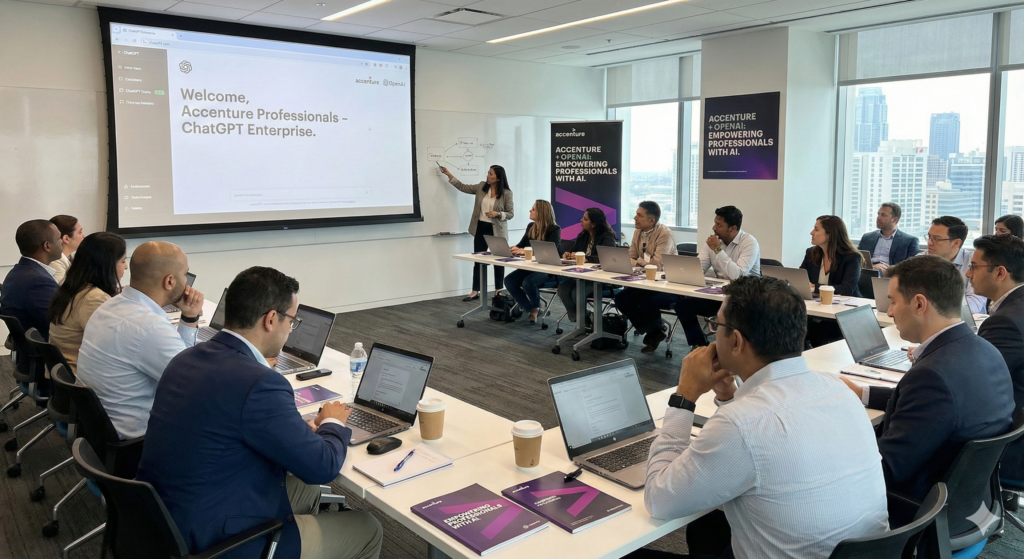
Accenture and OpenAI announced a partnership where Accenture will equip tens of thousands of its professionals with ChatGPT Enterprise and become one of OpenAI’s primary partners for next-generation AI-powered services. The firm plans to use the platform across consulting, operations, and delivery, alongside a flagship client program that helps organizations bring AI into every part of their business.
My take:
Steal the structure, even if your company is much smaller. Instead of scattered AI experiments, create a simple enablement program for a few high-leverage teams, with training and templates that match daily work. The tool is just one piece. The bigger shift is cultural: teaching people to “ask the AI first” for repetitive, text-heavy tasks so humans can stay focused on judgment and relationships. If Accenture sees this as core to its future, it is a strong signal for the rest of us.
From EY & Accenture insiders, broad adoption is still limited as training is also limited and not realistic for those on Mountain or PST. We were hired to train the employees at a large AI company in Silicon Valley, on how to use their own AI tool that they built! Training/upskilling current staff still remains the #1 opportunity for most companies.
Accenture and OpenAI
EU to open bidding for AI gigafactories in early 2026
According to the Wall Street Journal, the European Union expects to launch a formal bidding process for large-scale AI “gigafactories” in early 2026 as part of a push to build major AI infrastructure and catch up with the United States in the AI race. The plan aims to support the development of big compute and data centers to ensure data sovereignty, dedicated to artificial intelligence across the bloc, with details to be finalized ahead of the bidding window.
My take:
Even if you are not bidding on a gigafactory, this is your cue to watch for national and regional programs tied to AI infrastructure, skills, and data spaces. Keep an eye on grants, co-investment opportunities, and regulatory benefits for projects that align with these priorities. The businesses that move early tend to get the best support and the strongest relationships with policymakers.
Learn Practical Steps to Use AI in Every Day Tasks w/ Our Applied AI Course
What You’ll Learn in Our Level 1 Course
Our Applied AI Level 1 Certification isn’t about theory or fancy jargon. It’s about rolling up your sleeves and actually using these tools to get real work done.
Here’s what one of our recent students had to say:
“As the Chief Strategy Officer at Phoenix TS, I’ve had the privilege of participating in numerous courses designed to enhance our business operations and strategy. The 10-week course on business-applied AI with AI Smart Marketing was a standout experience. Instructors delivered a stellar curriculum that was not only engaging, but also richly informative. Their expertise in AI tools and strategies provided us with actionable insights that directly apply to our business. Implementing AI has allowed us to optimize our processes, resulting in increased efficiency and reduced costs; vital for staying competitive in today’s fast-paced market.”
– Ned S, Chief Strategy Officer, Phoenix TS
Sneak peek: What you’ll master in Lesson 2
Lesson 2: Prompt Engineering & Brand Voice
Stop playing prompt roulette. Learn the frameworks that get you better results every time – whether you’re asking for a project plan or a social media post. You’ll discover why the same prompt gives different results in ChatGPT vs. Claude vs. Gemini vs. CoPilot, and how to pick the right tool for each task.
10 Lessons + 10 Live Classes
Next Cohort: January

Streamline Your Business with AI Your Operations
AI Your Operations (AI Your Ops) is a live, hands-on program that helps business owners and teams turn repetitive, manual work into reliable, automated workflows. Instead of feeling stuck and unsure where to start, you get guided support to design systems that:
- Reduce manual workload
- Cut operational costs
- Improve accuracy and efficiency
- Free up time for strategy, innovation, and client service
Here is what participants are already building inside the course:
- Automated invoicing from website inquiries
An agency owner connected Gravity Forms to InvoiceNinja so every qualified inquiry creates an invoice automatically. No more manual data entry or chasing missing details. - Lead tracking from email outreach
A consultant uses Gmail, Zapier, and Notion so that when he applies a label in Gmail, a new lead record is created in his Notion tracker. - Quarterly systems reviews instead of daily babysitting
An operations leader lets her automations run in the background and reviews them on a set schedule, instead of monitoring every process each day.
Each workflow is simple on its own, but together they save hours every week, reduce errors, and create the stable operations needed for long-term growth.

Designing Your Life With AI: Health, Habits, and Visibility
Lessons and Tips from This Lab Session
First of all note that AI is NOT a medical professional, AI is NOT a doctor. We are not a medical doctors, and the information we provide is for educational and informational purposes only. It should not be considered medical advice, diagnosis, or treatment. Our responses are based on general research and publicly available information and may not apply to your specific health situation.
Always consult a qualified healthcare professional before:
- Starting or stopping any medication or supplement
- Making changes to your treatment plan
- Relying on any information to make medical decisions
If you are experiencing a medical emergency, call your local emergency services immediately.
- Let AI “put all of your experts in one room”
- Use AI to synthesize information from different specialists so you see the big picture, not isolated lab results.
- Upload office notes, blood work, imaging, and past recommendations. Then ask questions like:
- “What patterns do you see across all of this?”
- “What should I ask my doctor at my next visit?”
- Tip: Have AI help you draft emails, questions, and test requests so you feel confident and prepared at appointments.
- Prioritize privacy and safe environments for health data
- Use tools and accounts that keep your data private, and where possible, in compliant environments (for example, HIPAA compliant or region specific storage).
- Remove your name and personal identifiers before uploading labs or reports if you are unsure.
- Tip: Before you paste anything in, scan the document for sensitive data like IDs or socials and redact them.
- Personalize health routines instead of following generic advice
- One of us, used AI to turn her lab results into a simple summary, then asked for a personalized 7 day regimen tailored to her specific conditions and constraints. Layered genetic nutrition data on top of AI guidance to shape workouts, protein intake, sauna use, and red light therapy.
- Tip: Feed AI as much relevant context as you can: lab values, existing diagnoses, medications, schedule, access to equipment and preferences. Then ask for a realistic routine you could actually stick to.
- Ask for multiple perspectives, not just one viewpoint
- You can ask:
- “What would a functional medicine doctor say about this?”
- “How might a Chinese medicine doctor interpret these patterns?”
- “Where would Dr. Stacy Sims agree or disagree with this plan for women?”
- This gives you several frameworks to discuss with your real health team instead of one rigid “answer”.
- Tip: Always follow up with your medical provider. Use AI to expand your understanding and your questions, not to replace professional care.
- You can ask:
- Use AI to design your environment for wellness and ease
- AI can redesign your home gym, create layouts, suggest lighting and decor, and even generate a mood board.
- AI can reimagine awkward spaces, test different furniture layouts, and apply Feng Shui principles before buying anything.
- Tip: Upload photos and rough dimensions, then ask AI for:
- “Best layout for this room based on these items.”
- “Make this a calming wellness space with storage and minimal clutter.”
- Make healthy habits more fun and gamified
- Crystal’s “Bagel the raccoon” app uses AI to estimate calories and macros from food photos and turns hydration and fasting into a game.
- Framing it as “feeding the raccoon” instead of “tracking my diet” makes behavior change feel lighter and more sustainable.
- Tip: Look for or design systems where your health data is fun, a streak, or a score. Fun increases consistency.
- Think in “lenses” when you use AI
- Health lens: genetics, blood work, hormones, lifestyle.
- UX lens: environment, lighting, layout, mood.
- Business lens: AI visibility, competitors, search volume, buyer intent.
- Tip: When you ask AI for help, state your lens up front. For example:
- “From the perspective of a female in perimenopause with these lab results, what should I ask my doctor?”
- “From the perspective of AI SEO, what content should I prioritize for this URL in the next 30 days?”
- Treat AI as a collaborative partner, not a crystal ball
- The group used AI to: test regimens, redesign spaces, generate content ideas, and compare tools, then verified in the real world.
- The mindset is experiment, observe, adjust instead of “AI said it so it must be true.”
- Tip: Run time bound experiments. For example:
- “I will follow this AI informed health routine for 30 to 60 days and track how I feel plus key metrics.”
*AI Smart Ventures is creating a Health Assistant for Women that is trained on women’s research and HIPAA compliant, with data stored in Switzerland for security. If you want access, go to CycleWise.ai and give us your email, we’ll add you to the beta list when the platform opens to the public. It’ll be free for women for-ever!
Tools To Explore This Week
Here are three vetted tools from the AI Smart recommendations list that can support the kind of work you just read about:
- Suno AI – AI-powered music creation platform that empowers anyone to instantly generate high-quality, and personalized songs from simple text prompts.
- Open Forge AI – AIO platform for mastering AI search, leveraging advanced AI SEO and GEO-targeted insights to ensure your brand dominates the competition and wins more customers.
- OS CRM – Manage your client interactions through automations with this specialty CRM. Consistent nurturing, outreach, lead sourcing to grow your business without adding more employees.
Join the Conversation
Have questions, comments, or cool AI stories to share? We’re all ears and always looking to highlight insights from the AI community. Simply reply to this email or drop us a line at info@aismartventures.com.
Can’t wait to hear from you!
Cheers,
-Nicole A. Donnelly
Founder, AI Smart Ventures